Oil Pulling (Gandusha): How to Do It, Which Oil, What Research Says
Oil pulling is an Ayurvedic mouth practice where you hold or swish oil for about 10 to 15 minutes; this guide covers the method, the oil, the research and the cautions.
Key takeaways
- Ayurveda describes two versions: gandusha holds oil in a full mouth, and kavala swishes a smaller amount.
- Do it first thing in the morning on an empty stomach, spit the oil out, and then brush.
- Sesame is the classic oil, and Daisy dilutes concentrated Arimedadi thailam with sesame oil, 1 part to 4.
- Trials are small and often biased. They suggest a modest benefit for plaque and gums, and it does not replace brushing or a dentist.
- Never swallow the oil. Rare cases of lung inflammation have been reported after oil pulling.
Daisy's oil pulling routine
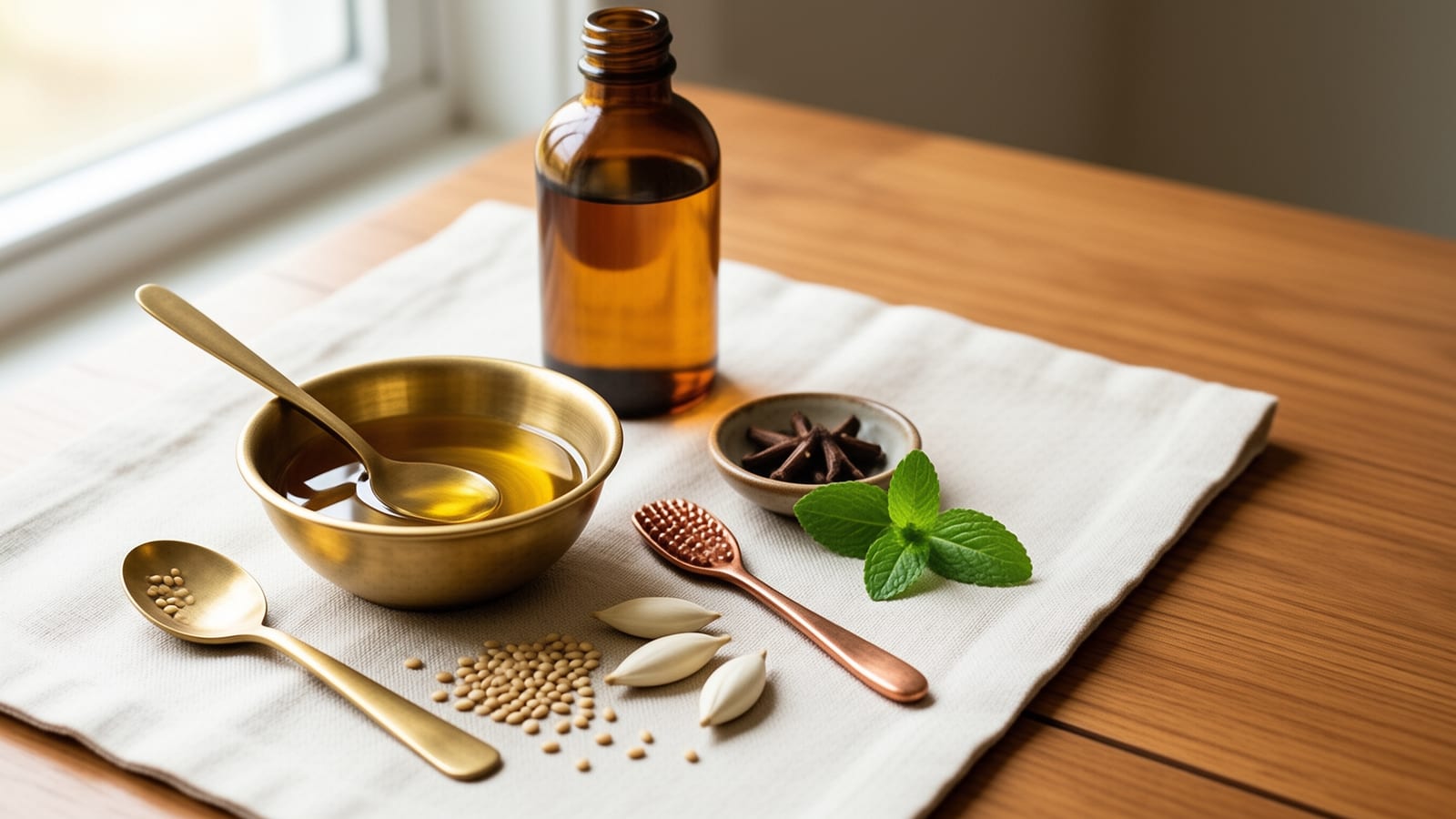
You need
- Arimedadi thailam and sesame oil, mixed 1 part to 4 parts (Daisy's blend), or plain sesame oil
- A clean bottle to keep the blend in
- A copper tongue cleaner
- A bin or tissue to spit into
- Lukewarm water and your tooth powder or toothpaste
Method
- Do this on an empty stomach, first thing in the morning.
- Clean your tongue with the tongue cleaner.
- Put a comfortable mouthful of the oil in your mouth. Daisy puts the oil straight from the bottle into her mouth.
- Swish gently, or hold it, for 10 to 15 minutes. Daisy gets ready for the day while she does this.
- Spit the oil into a bin or tissue, not the sink. Do not swallow it.
- Rinse your mouth with lukewarm water.
- Brush your teeth. Daisy uses an herbal tooth powder.
On this page (7 sections)
Dry mouth, coated tongue, bleeding gums and stale breath are common, and many of us brush hard and still feel the mouth is never quite clean. Ayurveda has an old answer that costs almost nothing: keep oil in your mouth for a few minutes every morning. Daisy does this daily, while she gets ready. This guide covers the method, the oils, the cautions and what studies say.
What is oil pulling?
Oil pulling means holding or swishing edible oil in your mouth for several minutes and then spitting it out. Ayurveda gives it two names. Gandusha fills the mouth fully, so the oil cannot move. Kavala uses less oil, leaving room to swish it around.
Both are described in the classical texts. According to Dr J V Hebbar, an Ayurvedic doctor, the Charaka Samhita says daily sesame oil pulling keeps the lips from cracking, the voice deep and the teeth firmly rooted. That is tradition, not a trial result. The modern studies come later in this guide.
How oil pulling fits into Ayurveda
Ayurveda sees oil pulling as part of dinacharya, the daily routine. It sits beside oil massage, nasal oil drops and bathing. The idea is that the mouth is a gateway, and oil keeps it moist, clean and strong.
Dr Hebbar describes the classical method. You sit in a draught-free spot with your face slightly lifted. You hold the liquid until the mouth fills with fluid or the nose and eyes begin to water, and then spit it out. Ayurveda also changes the liquid to suit the person. Oily, lubricating preparations are used for vata, the dry air-and-space dosha. Soothing ones suit pitta, the heat dosha. Sharper, warming ones suit kapha, the heavy and sticky dosha.
Which oil should you use?
Start with a plain edible oil. Sesame is the classical choice, and half the trials in a recent review used it. Coconut is the other oil with trial data. Dr Hebbar also suggests coconut, olive or almond oil for people with a lot of pitta heat.
Daisy uses a herbal blend. She mixes 1 part Arimedadi thailam with 4 parts sesame oil, because Arimedadi is concentrated. Arimedadi thailam is a medicated oil that Dr Hebbar calls the most common herbal oil prescribed for oil pulling. In her morning routine video, Daisy says she uses the Kottakkal brand. She keeps the blend in a bottle and puts it straight into her mouth.
In cold weather, warm the oil slightly. Dr Hebbar says a little warmth helps in winter.
How to do it step by step
The routine card above gives the order. A few details make it easier.
- Choose an empty stomach. Dr Hebbar says this is best, and it avoids stomach upset.
- Fill your mouth comfortably. Do not force a large amount.
- Swish softly. Hard swishing tires the jaw and can make you gag.
- Spit into a bin or tissue. Oil can block drains.
- Wash your face and rinse with lukewarm water. Brush after, as rinsing alone is not enough, says Dr Hebbar.
How often? Ayurveda lists oil pulling as a daily habit, and Dr Hebbar says it can be done daily over a lifetime. Most trials ran from one to eight weeks, so they say little about years of use. If your mouth feels sore, your throat feels coated or you feel sick, stop for a few days and try a smaller amount.
Who should be careful?
Never swallow the oil. Doctors have reported rare cases of lipoid pneumonia, a lung inflammation caused by oil entering the airways, after months of sesame oil pulling. If you cough or choke easily, or have trouble swallowing, skip it.
Young children may swallow the oil, so it is not for them. The Austrian trial team also noted that people with keratosis, a thickening of the skin’s surface, may have adverse effects. If you have gum disease, loose teeth or mouth lesions, ask your dentist first. If you take medicine for a long-term condition, keep your doctor in the loop.
What research says
The research is promising but weak. An 8-week trial in Innsbruck gave 40 people sesame oil or distilled water, 15 minutes each morning. Plaque fell more with oil, by a median of about 19 percent against 10 percent. Gum bleeding did not change, and the authors said bias could not be ruled out.
A review of 25 trials found a probable benefit for gum health, but rated the evidence very low in certainty. Chlorhexidine mouthwash was better than oil pulling at cutting plaque. A separate review of four coconut oil trials, with 182 people over 7 to 14 days, found lower plaque and fewer bacteria in saliva. It also called the studies mixed in quality and high in risk of bias.
So the fair reading is that oil pulling may be a cheap add-on to brushing. It is not a cure. The studies above measured plaque, gum health and bacteria counts. They did not test claims about clearing toxins from the body.
Daisy’s tips
- Do the tongue cleaning first, then oil pull, then brush with tooth powder.
- Dilute concentrated Arimedadi thailam with plain sesame oil, 1 part to 4.
- Use the swishing time to get ready, so it costs you no extra minutes.
- Use only a little tooth powder, about half to three-quarters of a teaspoon, with a few drops of water.
- Take the essentials of her routine and adjust them to your body and work hours.
Daisy also keeps a playlist of oiling practices on her channel, including oil pulling. Watch her morning routine below to see how oil pulling fits into her day. It takes about 27 minutes.
Questions people ask
What is the difference between gandusha and kavala?
In gandusha the mouth is filled with liquid and held still. In kavala a smaller amount is used and swished around. Both end with spitting the liquid out. Most people today call either one oil pulling.
How long should I oil pull?
Dr J V Hebbar, an Ayurvedic doctor, says it is usually about 10 minutes. The Austrian trial of sesame oil used 15 minutes every morning. Start with less if your jaw tires.
Which oil is best for oil pulling?
Sesame is the classical choice, and coconut is the other oil trials have tested. Daisy mixes 1 part Arimedadi thailam with 4 parts sesame oil because the herbal oil is concentrated.
Should I brush before or after oil pulling?
Daisy cleans her tongue first, oil pulls, then brushes with tooth powder. Dr Hebbar says rinsing alone is not enough and that you should brush after.
Can oil pulling replace brushing or a dentist?
No. Trials suggest it is a useful extra, and in one review chlorhexidine mouthwash reduced plaque more than oil pulling did.
Further reading
- Zürcher et al. (2025), Clinical Oral Investigations: Oil pulling with sesame oil, a randomised controlled study
- Jong et al. (2024), International Journal of Dental Hygiene: Oil pulling compared with chlorhexidine, a meta-analysis
- Woolley et al. (2020), Heliyon: Oil pulling with coconut oil, a systematic review
- Kuroyama et al. (2015), BMC Pulmonary Medicine: Lipoid pneumonia after repeated sesame oil pulling, two cases
- Dr J V Hebbar, Easy Ayurveda: Oil pulling the Ayurvedic way (summarising Charaka Samhita and Ashtanga Hridaya)
This article shares Daisy's personal experience and traditional Ayurvedic knowledge for general information. It is not medical advice. Talk to your doctor before changing medicines or treating a health condition, and patch-test anything new on your skin. Read the full disclaimer.
Learn it with Daisy
New natural remedies and Ayurvedic rituals on her YouTube channel every week.