Plant Protein for Indian Vegetarians and Vegans: A Daily Guide
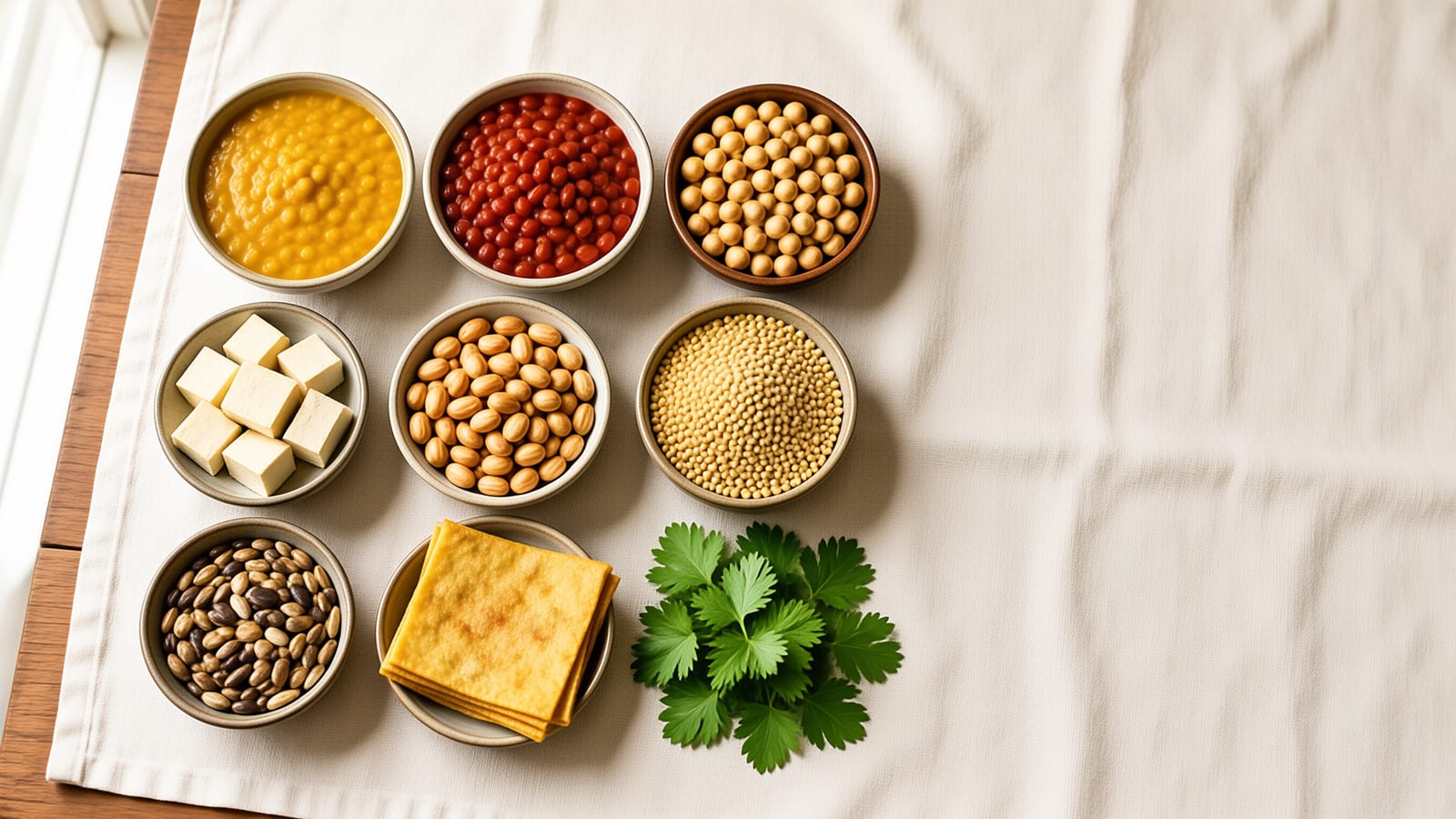
Most adults need about 0.8 g of protein per kg of body weight a day, and dals, beans, tofu, millets, nuts and seeds can cover it if you spread them across meals.
Key takeaways
- A common adult minimum is 0.8 g of protein per kg of body weight a day. Work out your own number first.
- Dals, beans, soy, tofu, nuts and seeds are the main plant protein foods. Whole grains and millets add more.
- Eat a variety of protein foods through the day. You do not need to engineer every plate.
- Spread protein across meals. About seven small portions of dal, beans or tofu can reach 50 g.
- Vegans need a reliable B12 source. Daisy relies on fortified foods and supplements.
- Daisy soaks beans and dals, rotates them through the week, and adds seeds and nuts daily.
On this page (9 sections)
Many Indian vegetarians and vegans worry that dal and roti cannot add up to enough protein. The worry is often bigger than the real gap. Plant foods can meet adult protein needs when you eat enough of them and vary them through the week. Daisy has eaten plant-based for decades. This guide covers how much you need, which foods carry the most, and how to reach your number every day.
What is protein, and how much do you need?
Protein is the nutrient your body uses to build and repair its cells. It is made of amino acids. Nine of them are called essential, because they must come from food.
The National Academy of Medicine sets a minimum of 0.8 g of protein per kg of body weight per day for adults, as Harvard’s nutrition guide explains. Multiply your weight in kg by 0.8. At 55 kg, that is 44 g. At 70 kg, it is 56 g.
Harvard also notes that needs vary with age, exercise level and health. Treat the number as a starting point, not a target to chase.
The best plant protein foods in an Indian kitchen
Dals, beans and pulses. The NHS calls pulses, meaning beans, peas and lentils, a low-fat source of protein and fibre. It says they matter most for people who do not eat meat, fish or dairy. Daisy points out that a local kirana can stock 20 kinds of beans. She names chawli, green chana, brown chana, double beans, rajma and chickpeas.
Soy and tofu. The NHS lists tofu, tempeh and textured vegetable protein as meat alternatives. MedlinePlus counts about 7 g of protein in a quarter cup of tofu, and the same in half a cup of cooked beans or lentils. Daisy often has soy milk, and her tofu, cheela and smoothie Shorts show how she uses it.
Millets and whole grains. MedlinePlus notes that whole grains hold more protein than refined ones. Dr. Khadar Vali told Daisy that millets give about 7 to 12 g per 100 g, with brown top and foxtail richest. He also said dals carry a lot of starch alongside their 20 to 24% protein. His advice was to eat dal in smaller amounts and rotate millets. That is his view, and it differs from the NHS, which counts pulses as a core protein food.
Nuts and seeds. The NHS lists these as protein sources too. Daisy eats two spoonfuls of soaked sesame seeds every day. She also names pumpkin seeds, hemp seeds, cashews and pine nuts.
Do you need to match foods at every meal?
The old rule said you must pair dal with rice in the same meal. Today’s advice is looser. The NHS says to eat a variety of protein sources to get the right mix of amino acids.
A 2019 review in Nutrients went further. It found that legumes, nuts and seeds can give adults full protein adequacy. It also said fears of amino acid shortfalls have been overstated. Dal and rice remain a good pair, but you need not plan around them.
How to reach your number every day
- Work out your target using the 0.8 g per kg figure.
- Put one clear protein food in each meal. MedlinePlus counts about 7 g in a quarter cup of tofu or half a cup of cooked beans or lentils. Seven such portions come to about 49 g, before grains, nuts, seeds and vegetables add more.
- Spread the foods across the day, for example moong cheela or tofu scramble, dal with millets, soaked seeds as a snack, and a bean soup or tofu sabzi at night.
- Rotate the beans. Daisy has one kind of bean a day, and changes it the next day.
- If you are unsure whether you eat enough, ask a doctor or dietitian to review your diet.
Keeping dals and beans gentle on the gut
Daisy soaks dals overnight. She cooks them with hing (asafoetida), ginger, mustard seeds and garam masala. She also includes fermented foods in her meals, such as idli, dosa and dhokla.
She adds a caution for thin, dry, gassy people, whom Ayurveda calls vata types. She says most beans are hard for them to digest, and keeps legumes to about 10% of the plate in her plan for them. Her examples there are moong dal khichdi and tofu.
What about B12?
B12 is a vitamin, not a protein, but it matters for anyone cutting out animal foods. Vegans need a reliable source. Daisy’s separate B12 article and video cover this in full. Her own go-to is fortified nutritional yeast, plus a supplement chosen after a blood test.
Who should be careful
Check with a doctor or dietitian before changing your protein if you have kidney disease, are pregnant, are older, or train hard. The 2019 review says protein adequacy is more complex in older adults. If you take medicine for diabetes, BP, thyroid or PCOS, keep your doctor in the loop.
What research says
The Academy of Nutrition and Dietetics states that well-planned vegetarian and vegan diets are nutritionally adequate for all stages of life, including pregnancy and athletes. It adds that vegans need reliable B12.
The Nutrients review looked mainly at adults in Western countries. Indian staples were not its focus, so use it as a guide rather than a guarantee. Dr. Vali argues for much lower protein than mainstream guidance. Treat that as one expert’s view.
Daisy’s tips
- Soak dals, beans, nuts and seeds before you cook or eat them.
- Rotate the beans through the week instead of repeating one.
- Add two spoonfuls of seeds a day. Daisy uses soaked sesame.
- Include fermented foods like idli and dosa with meals.
- Get a B12 blood test before you supplement, and ask your doctor about the dose.
- If you are thin or gassy, go slowly with beans and ask your doctor or dietitian.
Daisy goes deeper on B12, the vata plate and millets in the videos below.
Questions people ask
How much protein does a vegetarian or vegan need?
The National Academy of Medicine sets a minimum of 0.8 g per kg of body weight per day for adults. For a 140-pound (about 63 kg) person, Harvard's nutrition guide puts that at about 50 g. Needs rise or fall with age, exercise and health.
Can dal and rice give enough protein?
They can contribute a lot, but they work best as part of a varied day with other beans, tofu, nuts, seeds and whole grains. A 2019 review found that legumes, nuts and seeds can fully meet adult protein needs.
Do I need to combine foods at every meal?
Not meal by meal. The NHS advises eating a variety of protein foods to get the right mix of amino acids. A 2019 review says worry about amino acid shortfalls has been overstated.
Do vegans need a B12 supplement?
Yes. The Academy of Nutrition and Dietetics says vegans need a reliable B12 source, such as fortified foods or supplements. Daisy takes the same view and covers it in her B12 video.
Does Daisy think millets replace extra protein?
Dr. Khadar Vali, in his talk with Daisy, argues that most people need no extra protein because millets already provide it. This is his view and it differs from mainstream guidance, so check with a doctor or dietitian.
Further reading
- Harvard T.H. Chan School of Public Health: Protein, how much do I need?
- MedlinePlus: Protein in diet
- NHS: The vegetarian diet
- Mariotti and Gardner, 2019: Dietary protein and amino acids in vegetarian diets, a review (Nutrients)
- Melina, Craig and Levin, 2016: Position of the Academy of Nutrition and Dietetics, vegetarian diets
This article shares Daisy's personal experience and traditional Ayurvedic knowledge for general information. It is not medical advice. Talk to your doctor before changing medicines or treating a health condition, and patch-test anything new on your skin. Read the full disclaimer.
Learn it with Daisy
New natural remedies and Ayurvedic rituals on her YouTube channel every week.