Natural Hair Oils: Which Oil for Which Hair Problem
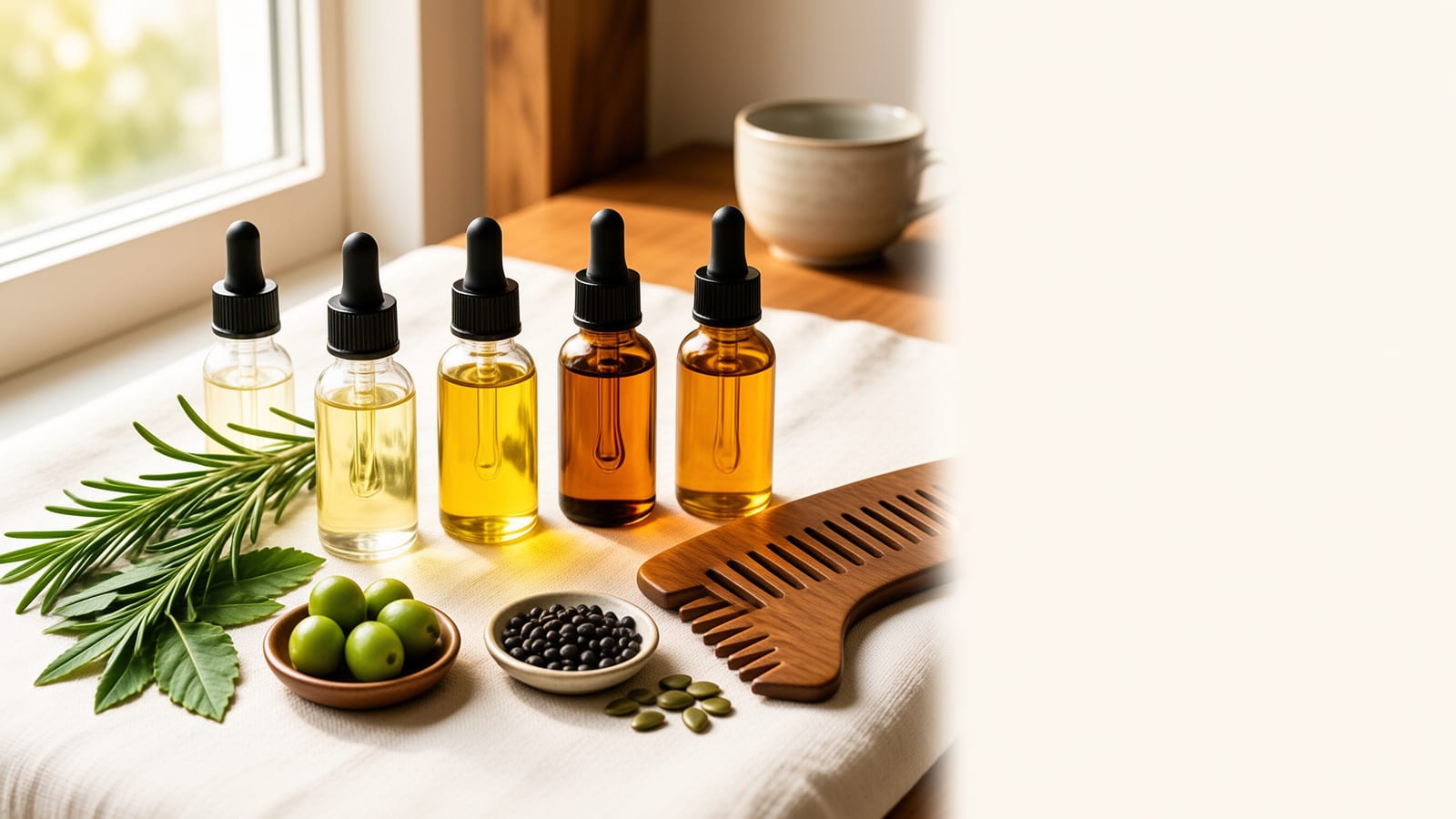
Rosemary has the best human evidence for thinning hair, coconut oil protects the hair shaft, and castor, bhringraj, kalonji and amla are Ayurvedic favourites that Daisy blends.
Key takeaways
- No single oil fits every problem. Match the oil to your main concern: thinning, dry lengths or a weak scalp.
- Rosemary oil has the best human evidence. A 6-month trial found it raised hair count as much as minoxidil 2%.
- Coconut oil is the one oil shown to cut protein loss in hair. Mineral and sunflower oil did not.
- Bhringraj and amla have lab and animal studies only. Castor and kalonji have little controlled human data.
- Daisy mixes castor, bhringraj, onion, kalonji, pumpkin seed, amla, saw palmetto and rosemary into one scalp oil.
- Oil the scalp, not the lengths, massage gently, and test a new oil on a small patch of skin first.
Daisy's overnight scalp oiling routine
You need
- Your chosen oil or blend, in a clean glass bottle
- A plastic cover inside the pillowcase (Daisy's tip)
- Reetha or soapnut wash for the next morning
Method
- Warm a small amount of the oil a little. Do not overheat it.
- Part your hair into sections and apply only to the scalp. Aim for a thin film, not a soak.
- Massage gently for 10 to 15 minutes with your fingertips. Do not use your nails.
- Leave the oil on overnight.
- Wash it out the next day with a gentle wash such as reetha. Daisy does this on thick, curly hair nightly. With an oily scalp, twice a week is enough.
On this page (7 sections)
Walk into any shop and you will find shelves of hair oils, each promising thicker hair. Most readers want one simple answer: which oil for which problem. There is no single winner, because thinning hair, dry lengths and a flaky scalp need different things. This guide goes oil by oil, says what is known and what is tradition, and ends with how Daisy oils her scalp.
What are natural hair oils, and how do they work?
A hair oil is a plant oil, or a blend of oils, applied to the scalp or hair. Some sit on the surface and soften the strand. Others are used on the scalp with massage, in the hope of helping the follicle, the small pocket where each hair grows.
Ayurveda has oiled the scalp for centuries. Daisy follows that tradition. She says her blend works because the oils go in together and the effect compounds. Research is thinner than tradition, so each oil below is rated by its evidence.
Which oil for which hair problem?
Thinning hair or pattern hair loss: rosemary. Rosemary is the best-studied oil here. A 6-month trial put 100 people with pattern hair loss on rosemary oil or minoxidil 2%. Hair count rose in both groups, with no clear difference between them. Daisy calls rosemary oil one not to cheap out on.
Hair loss linked to DHT: pumpkin seed. DHT is a hormone that shrinks hair follicles. A 24-week trial gave 76 men pumpkin seed oil capsules, 400 mg a day, to swallow. Their hair count rose about 40%, against about 10% on placebo. It did not test oil on the scalp. Daisy adds it to her scalp blend because it is rich in zinc.
Weak, slow growth: bhringraj. Bhringraj (Eclipta alba) is Ayurveda’s classic hair herb, and Daisy calls it the king of herbs for hair. A rat study found its extract started hair growth sooner. Human trials are lacking.
Scalp and DHT support: amla. Daisy takes amla juice daily and adds amla oil to her blend. She says amla’s EGCG, a plant compound, blocks DHT from shrinking follicles. A lab study found amla extract blocked 5-alpha reductase, the enzyme that makes DHT. That was in a test tube, not on scalps.
Follicle support: kalonji. Kalonji is black seed oil. Daisy says its thymoquinone helps regenerate follicle cells. We did not find controlled human trials of kalonji oil for hair.
Dry, brittle lengths: coconut. A lab study found coconut oil cut protein loss in hair. Mineral oil and sunflower oil did not. Daisy suggests plain coconut oil on the lengths the night before a wash.
A heavy base for the blend: castor. Daisy cites the Ayurvedic text Bhaishajya Ratnavali, which she says calls castor oil the lion of oils. She says it penetrates deeper than other oils. She also uses it on eyebrows, lashes and beard. Human trials on hair are lacking, so keep it away from your eyes.
How to oil your scalp properly
Daisy puts oil on the scalp, not the length. She applies a thin film in sections, massages, and leaves it overnight. She warms the oil first and says the scalp absorbs better as you sleep.
Daisy oils nightly because her hair is thick and curly. With straight hair, she says to oil daily for a few weeks, then reduce. With an oily scalp, twice a week is enough.
Massage matters too. Daisy recommends 10 to 15 minutes a day, gently and without nails. She says it warms the scalp and deepens sleep. Her tip for the pillow is a plastic cover inside the pillowcase.
Buying and mixing oils
Daisy’s advice is to avoid oils with fragrance, phenoxyethanol, benzyl compounds, emulsifiers or surfactants. If an oil smells strong and artificial, she says, it is not natural. Prefer oils with a short, clear ingredient list.
She makes her own blend of about 800 ml. It contains castor, bhringraj, onion, kalonji, pumpkin seed, amla, saw palmetto and rosemary. Her full recipe is in her video on genetic hair loss.
Who should be careful
Essential oils such as rosemary can cause skin allergy. A dermatology review lists essential oils that have caused contact allergy. Dab a small amount on your inner forearm and wait a day before using a new oil on your scalp.
Daisy agrees that a very oily scalp needs less oil. If a dermatologist has told you to avoid oiling, follow that advice. Hormones, insulin and gut health drive a lot of hair loss, and no oil fixes them. See a doctor if hair loss is sudden, patchy, itchy or painful, or comes with weight gain, exhaustion or irregular periods. If you take medicine for hair loss, thyroid or PCOS, keep your doctor in the loop.
What research says
Only rosemary has a human trial against a standard treatment, and that trial was small and lasted six months. Hair count did not change at 3 months, only at 6. Scalp itching rose in both groups. So give any oil several months before judging it. Pumpkin seed has a good trial, but it tested capsules. Bhringraj and amla have lab or animal data. Castor and kalonji have tradition and little controlled data. Coconut oil protects the hair shaft in lab tests, which is different from growing new hair.
Daisy’s tips
- Expect results in months. Daisy says visible change takes about 4 to 5 months.
- Oil the scalp, massage gently, and leave it overnight.
- Warm the oil a little before applying.
- Wash with reetha or soapnut. Daisy avoids sulfate and silicone products.
- Pair oiling with food, sleep and stress care. She says oil is only one piece.
Daisy shows her blend, her washing routine and her conditioner recipes in the videos below.
Questions people ask
Which oil is best for hair fall?
Rosemary oil has the most human evidence. In a 6-month trial of 100 people with pattern hair loss, rosemary oil raised hair count about as much as minoxidil 2%. Daisy also uses castor, bhringraj, kalonji, pumpkin seed and amla oil in her blend.
Does castor oil really grow hair?
Daisy uses castor oil as the base of her hair oil and says it carries other oils deeper. We did not find controlled human trials showing that castor oil regrows hair. Treat it as a traditional oil.
Can I leave hair oil on overnight?
Daisy says yes. She says the scalp absorbs better at night. If your scalp is oily, she suggests oiling twice a week. If a doctor has told you to avoid oiling, follow that advice.
Does pumpkin seed oil work on the scalp?
The trial that found benefit gave pumpkin seed oil capsules by mouth to men with pattern hair loss. It did not test oil on the scalp. Daisy adds pumpkin seed oil to her scalp blend because it is rich in zinc.
Do hair oils fix hormonal hair loss?
Daisy says hormones, insulin and gut health sit behind a lot of hair loss. See a doctor if hair fall comes with weight gain, exhaustion or irregular periods.
Further reading
- Panahi et al., 2015: Rosemary oil vs minoxidil 2% for androgenetic alopecia, a randomized comparative trial (Skinmed)
- Cho et al., 2014: Effect of pumpkin seed oil on hair growth in men with androgenetic alopecia (Evid Based Complement Alternat Med)
- Roy et al., 2008: Hair growth promoting activity of Eclipta alba in male albino rats (Arch Dermatol Res)
- Kumar et al., 2012: 5-alpha-reductase inhibition and hair growth promotion of some Thai plants (J Ethnopharmacol)
- Rele and Mohile, 2003: Effect of mineral oil, sunflower oil and coconut oil on prevention of hair damage (J Cosmet Sci)
- de Groot and Schmidt, 2016: Essential oils, part III, chemical composition (Dermatitis)
This article shares Daisy's personal experience and traditional Ayurvedic knowledge for general information. It is not medical advice. Talk to your doctor before changing medicines or treating a health condition, and patch-test anything new on your skin. Read the full disclaimer.
Learn it with Daisy
New natural remedies and Ayurvedic rituals on her YouTube channel every week.


